The Contractor's Guide to Conversion Funnels: Turn Browsers Into Buyers

March 17, 2026

Share this article

Introduction

If your website gets traffic but your phone isn’t ringing the way it should, you don’t have a traffic problem — you have a conversion problem.


Every day, homeowners are browsing contractor websites, comparing options, and quietly eliminating businesses that don’t make the next step clear. They may like your work. They may trust your reputation. But without a structured path forward, they leave — and often never come back.


This is where conversion funnels change everything.


A conversion funnel isn’t about flashy marketing or aggressive sales tactics. It’s about guiding homeowners through a clear, confidence-building journey — from first click to first conversation — so browsing turns into buying.

This guide breaks down how conversion funnels work for contractors, why they’re essential for growth, and how the right system turns digital interest into qualified leads consistently.

Happy entrepreneur reviewing a digital marketing guide in a modern office

Why Most Contractor Websites Don’t Convert

Browsers Aren’t Ready to Buy Immediately

Homeowners rarely land on your site ready to book. They’re researching, validating, and comparing. When websites assume instant readiness, they create friction.


High-performing contractor funnels respect the homeowner’s decision process instead of rushing it.

Too Many Choices Kill Action

Many contractor sites overwhelm visitors with options: multiple CTAs, scattered messaging, and unclear priorities. When homeowners don’t know what to do next, they do nothing.


A conversion funnel simplifies decision-making by presenting
one logical next step at a time.

Traffic Without Nurturing Leaks Opportunity

Even interested homeowners may not convert on the first visit. Without lead capture and follow-up, those visitors are gone forever.


Funnels exist to
capture interest early and nurture it over time.

What a Conversion Funnel Actually Is (For Contractors)

A Funnel Is a Guided Buyer Journey

For homeowner-facing contractors, a conversion funnel maps how someone moves from:


  • Awareness (“I’m exploring options”)
  • Consideration (“I’m narrowing my list”)
  • Trust (“I feel confident in this contractor”)
  • Action (“I’m ready to talk”)


Each stage requires different messaging, content, and calls to action.

Funnels Align With How Homeowners Decide

Research consistently shows buyers need multiple touchpoints before taking action. Funnels create those touchpoints intentionally — through content, follow-up, and reassurance — rather than leaving conversions to chance.

Core Stages of a High-Converting Contractor Funnel

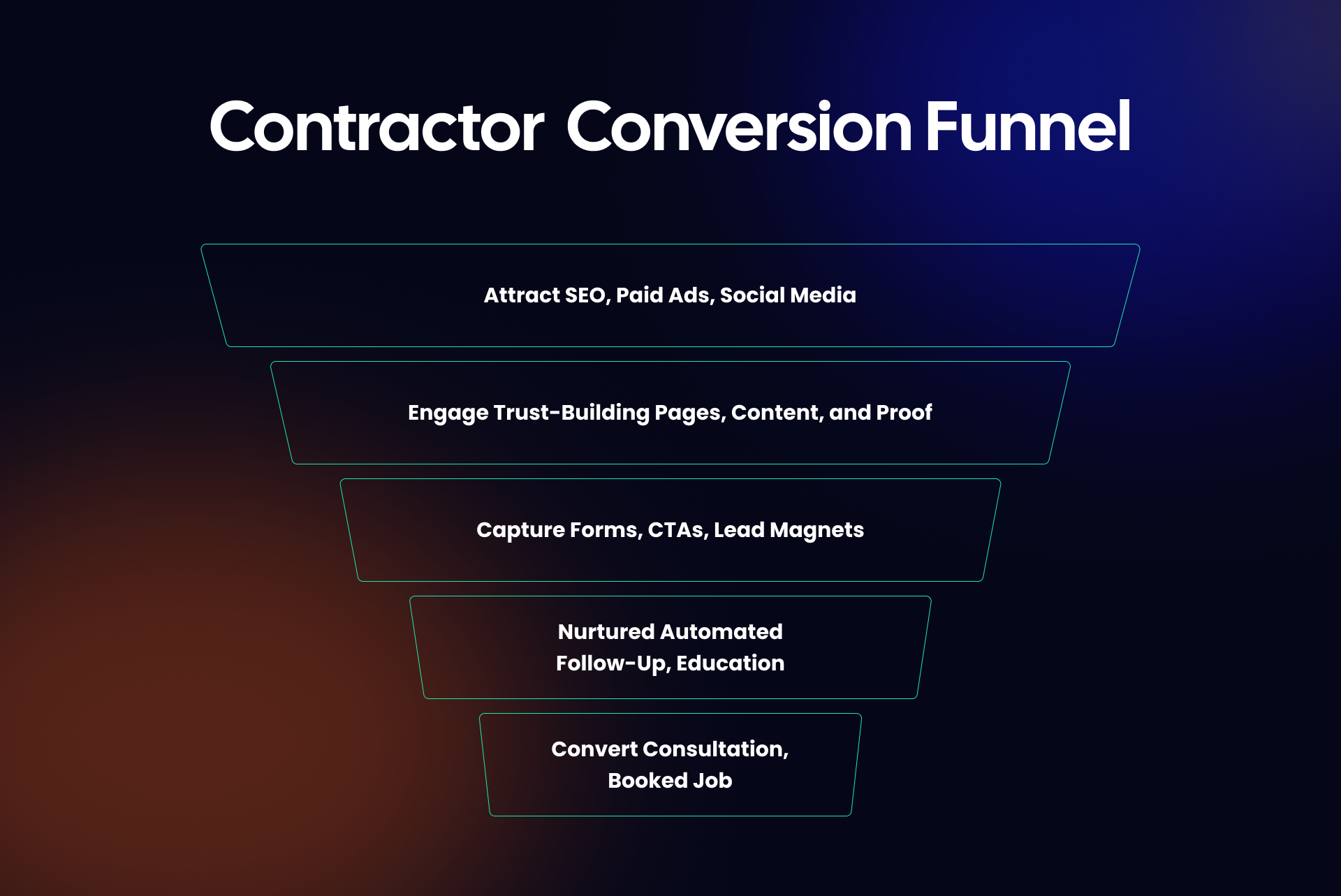
Stage 1: Attraction (Bring the Right Homeowners In)

Effective funnels start by attracting qualified traffic — homeowners who are actually a fit.


  • This includes:
  • SEO-driven content
  • Paid ads with clear intent
  • Educational messaging
  • Trust-building visuals


Attraction isn’t about volume — it’s about relevance.

Stage 2: Engagement (Build Trust Quickly)

Once on your site, homeowners need reassurance. This is where conversion-focused pages, clear messaging, and educational content matter.


Engagement answers silent questions:

  • Can I trust you?
  • Do you understand my problem?
  • Do you feel professional and reliable?


This stage is where many contractor websites fall short.

Stage 3: Capture (Turn Visitors Into Leads)

A funnel must give homeowners a low-friction way to raise their hand.


This doesn’t always mean “Book Now.” It can be:

  • A consultation request
  • A planning guide
  • A pricing explainer
  • A design questionnaire


The goal is to capture interest — not force commitment.

Stage 4: Nurture (Move Leads Toward Confidence)

Most conversions happen after follow-up.


Lead nurturing — through automated emails, texts, or content — keeps your brand top-of-mind, answers objections, and builds comfort before the first call.


Nurtured leads convert at significantly higher rates than cold ones.

Stage 5: Conversion (Make the Next Step Easy)

When homeowners are ready, the funnel should make booking simple and clear. No confusion.


No friction. No pressure.


Conversion happens when clarity meets readiness.

Diagram of the Contractor Conversion Funnel stages from lead attraction to booked job

Why Funnels Increase Qualified Leads (Not Just More Leads)

Funnels Filter Out Poor-Fit Prospects

Good funnels educate early. That naturally weeds out homeowners who aren’t aligned with your pricing, process, or scope.


This saves sales teams time and improves close rates.

Funnels Pre-Sell Trust Before the Sales Call

When homeowners understand your process and expectations before speaking with you, sales conversations become easier, shorter, and more productive.


Trust is built before the call — not during it.

Common Funnel Mistakes Contractors Make

Treating the Website as a Digital Brochure

Websites that only showcase projects but don’t guide action leave money on the table. A funnel-driven site leads visitors somewhere intentionally.

Ignoring Follow-Up Automation

Capturing a lead without nurturing it is like collecting business cards and never calling them. Funnels must include automated follow-up to protect interest.

Measuring Traffic Instead of Conversions

Traffic is meaningless if it doesn’t convert. Funnels shift focus to what matters: conversion rate, lead quality, and sales outcomes.

Why Conversion Funnels Work Best Inside a Unified System

Funnels Touch Marketing, Sales, and Operations

A funnel doesn’t stop at the form fill. It flows into:


  • CRM
  • Follow-up sequences
  • Sales pipeline
  • Customer experience


When these systems aren’t connected, leads fall through the cracks. That's why the 
ClearPath Buying Experience is designed to keep prospects moving smoothly from interest to commitment.

Visibility Creates Optimization

When funnel data is centralized, contractors can see where prospects stall — and fix issues proactively instead of guessing.

How CyberFunnels Turns Browsers Into Buyers

Conversion funnels are only as strong as the system behind them.


CyberFunnels was built specifically for homeowner-facing contractors to unify:


  • Traffic generation
  • Conversion-focused SmartSites
  • Lead capture
  • Automated nurturing
  • Sales pipeline workflows


Instead of piecing together tools, CyberFunnels creates
one cohesive conversion engine that guides homeowners from first click to booked job — consistently and predictably.


This is why contractors using structured funnels see:


  • Higher conversion rates
  • More qualified leads
  • Shorter sales cycles
  • Stronger close rates

Final Takeaway: Funnels Turn Interest Into Revenue

Homeowners are already browsing your site.


The question is whether you’re guiding them — or losing them.


Conversion funnels don’t pressure buyers.
They
remove confusion, build trust, and make the next step obvious.
For contractors looking to grow in competitive markets, funnels aren’t optional — they’re foundational.


When implemented inside a unified system, conversion funnels turn digital attention into real opportunities — and browsers into buyers.

Build a Funnel That Converts

If your website traffic isn’t turning into qualified leads, your funnel needs structure — not more traffic.


Schedule a Free Consultation to see how CyberFunnels can help contractors like you build conversion funnels that actually close deals.

Recent Posts

Construction worker in yellow hard hat and reflective vest applying plaster to a wall on site
August 22, 2026
For many pool builders, increasing sales can feel like a constant challenge. The traditional approach is often focused on competing with other companies on price, offering discounts, or trying to convince homeowners why one option is better than another. However, the most successful pool companies do not win by being the cheapest. They win by creating confidence, demonstrating value, and providing a better experience throughout the buying process. Today’s homeowners are looking for more than a contractor. They want a trusted partner who can guide them through a significant investment and help them create the right backyard for their lifestyle. By improving the sales experience , pool builders can increase close rates, reduce price objections, and create more opportunities to sell higher-value projects.
August 15, 2026
The way homeowners make purchasing decisions has changed. Today’s customers are no longer influenced only by bigger promises or lower prices—they are influenced by better experiences. Before choosing a pool builder, homeowners often research online, compare options, explore designs, and look for companies that can provide confidence throughout the process. They want to understand their choices and feel prepared before making a major investment. For pool companies, this shift represents an opportunity to rethink the traditional sales process. The builders who create a more transparent, engaging, and customer-focused buying experience can differentiate themselves, build stronger relationships, and create a more effective path from lead to project.
Hands typing on a laptop at a wooden café table, with a smartphone beside it.
August 8, 2026
Not every homeowner who contacts a pool company is ready to build. While generating leads is important, the real opportunity for pool builders comes from identifying which prospects have the goals, expectations, and commitment needed to move forward. Many pool companies spend valuable time meeting with homeowners who are still exploring ideas, comparing prices, or trying to understand whether a pool project fits their budget. Without an effective pool builder lead qualification process , designers can lose valuable hours on consultations that are unlikely to convert. A modern sales process helps builders understand homeowners earlier, create better conversations, and focus their time on qualified buyers who are more prepared to make a decision.
August 1, 2026
The pool industry has changed, but many sales processes have not. Today’s homeowners research their options, compare companies, and expect a more transparent buying experience before making a major investment.  However, many pool builders still rely on a traditional sales approach that requires designers to spend hours traveling, preparing proposals, and meeting with homeowners before knowing if they are truly ready to move forward.
Hands typing on a laptop at a wooden table in a bright office setting
June 23, 2026
Discover the difference between a traditional pool builder sales process and a modern buying experience, and why it matters for winning more projects and reducing price pressure.
Family playing in a pool at a sunny tropical resort, smiling and splashing water
June 16, 2026
Understand how today's pool buyers research, evaluate, and make decisions so you can adapt your process and win more projects in a competitive market.

Video call on a desktop monitor in a blue-lit office, with a person at the desk facing the screen.
June 9, 2026
Learn how pool builders can increase sales and margins without spending more on ads by improving their pool buying experience and converting more existing opportunities.

Woman in a green shirt taking notes at a desk beside a laptop and notebook
June 2, 2026
Discover why pool builders lose projects to lower-priced competitors and how a better pool buying experience can increase conversions and margins.
May 25, 2026
Learn how to improve close rate for pool builders by fixing your sales process, buying experience, and follow up instead of relying on more leads.
May 18, 2026
Learn how fast contractors should respond to leads and why speed to lead is critical for winning more jobs in today’s competitive market.
Show More